Singapore has hundreds of car workshops, and from the outside they all say the same things: experienced, honest, cheap. Most drivers pick one from a Google search, cross their fingers, and only find out what they chose when something goes wrong.
You can do much better than that in about ten minutes. Here is the checklist we would use ourselves.
1. Ask what diagnostic system they run for your car
This is the fastest filter there is, especially for continental cars. A generic OBD reader can pull basic fault codes, and for simple faults that is enough. What it cannot do is see deep into a modern continental car: each marque has its own dealer-level system that reads every module, runs guided tests and codes new parts in.
So ask one question: "What diagnostic system will you put on my car?" For a Porsche the answer should be PIWIS. For a BMW or MINI, ISTA. For a Mercedes, XENTRY. For an Audi or Volkswagen, ODIS. For a Volvo, VIDA. For the serious work on a continental car, a workshop that cannot name the system for your marque is working with one eye closed, and what the tool cannot see tends to get billed to you as parts.
2. Ask what happens before the quote
A proper workshop diagnoses first, then quotes, then waits for your approval. Be wary of a firm final price quoted over the phone for internal work like a gearbox or engine problem: a scan can point to the fault area, but nobody knows exactly what a worn gearbox needs inside until it is opened. A firm number before anyone has looked at the car is a guess, and the gap between the guess and reality usually reappears later as "we found something else".
Ask upfront how the diagnosis is charged: free, free when you repair there, or billed either way. All three are legitimate, because a proper diagnosis takes real scan time and skilled hours. The green flag is a workshop that states its policy plainly before the car goes up on the hoist. The red flag is one that reveals the conditions only after the check is done.
3. A real warranty is a number in writing
"Don't worry, we stand behind our work" is not a warranty. A warranty is a number: how many months, how many kilometres, on what exactly, in writing on your invoice.
As a benchmark, here is what we put in writing: 2 years or 40,000km, whichever comes first, on a full gearbox overhaul; 3 years or 60,000km, whichever comes first, on an engine overhaul; 1 year on aircon repairs; and at least 6 months on electrical repairs. Routine servicing carries no workmanship warranty with us; we state a warranty only where one genuinely applies. When you compare workshops, compare their written numbers on the same job, and notice which jobs a workshop is willing to warrant at all: that tells you where it trusts its own work.
4. Read reviews the way a mechanic reads symptoms
Star ratings alone say little. Look for three things instead. Volume and recency: a handful of five-star reviews could be friends and family; hundreds of detailed reviews spread over years are far harder to fake. Specifics: reviews that name the car, the job and what happened are worth ten generic "good service!" ones. And how the workshop replies to the bad reviews, because every workshop has some, and the reply shows you how they will treat you when something goes wrong.
5. Insist on documented work
A good workshop shows you what it did: photos of the worn parts, the old parts back if you want them where the part is not an exchange unit (reconditioned units usually go back to the supplier as cores, and a good workshop says so upfront), and a clear record of what was replaced. If a workshop can show you write-ups of past jobs on cars like yours, with the fault, the fix and the final bill, that is the strongest evidence there is, because it is checkable. Ask to see examples.
6. Root cause beats the parts cannon
The expensive habit in this industry is replacing parts until the symptom goes away, at your cost. The question to ask is: "What is the actual cause, and how do you know?" A workshop that can explain the mechanism, in plain language, before spending your money, is the one that fixes the car once. A workshop that says "change this first, then we see" is experimenting with your wallet.
7. Match the workshop to the car
A general workshop can be excellent for a Japanese runabout and out of its depth on a DSG fault or an air suspension failure. Continental cars fail in marque-specific ways, and a specialist who has seen your exact fault many times before will usually find it faster, because they start from a shortlist instead of a blank page. If you drive a continental car, ask how often they work on your marque and what the common faults are; a real specialist will answer with specifics before you finish the question.
8. The quote itself tells you plenty
A trustworthy quote is itemised: each part, each job, labour, and whether GST is included. It states the parts grade in writing, whether new OEM-grade parts, genuine agent parts, or quality reconditioned units, so you can compare like with like. A one-line quote with a single number hides everything you would want to compare, and makes it easy to swap parts grades on you later.
The red flags, collected
- A firm final price for internal work before anyone has looked at the car
- Cannot tell you what diagnostic equipment they would use on your marque
- Warranty is verbal, vague, or "lifetime"
- One-line quotes with no itemisation and no parts grade
- Pressure to commit today, or scare stories without evidence
- No photos, no old parts, no documentation of what was done
The questions to copy and paste
Send these on WhatsApp before you commit to any workshop, ours included:
- What diagnostic system will you use on my car?
- Is the diagnosis free, and is there any obligation after it?
- Will the quote be itemised, with the parts grade stated in writing?
- What warranty do you give on this exact job, in months and kilometres?
- Can I see a write-up or photos of a similar job you have done?
- Will you show me the worn parts you replace?
- If the fault comes back, what happens?
A good workshop answers all seven happily. A workshop that gets defensive at these questions has answered them too.
Where we stand on our own checklist
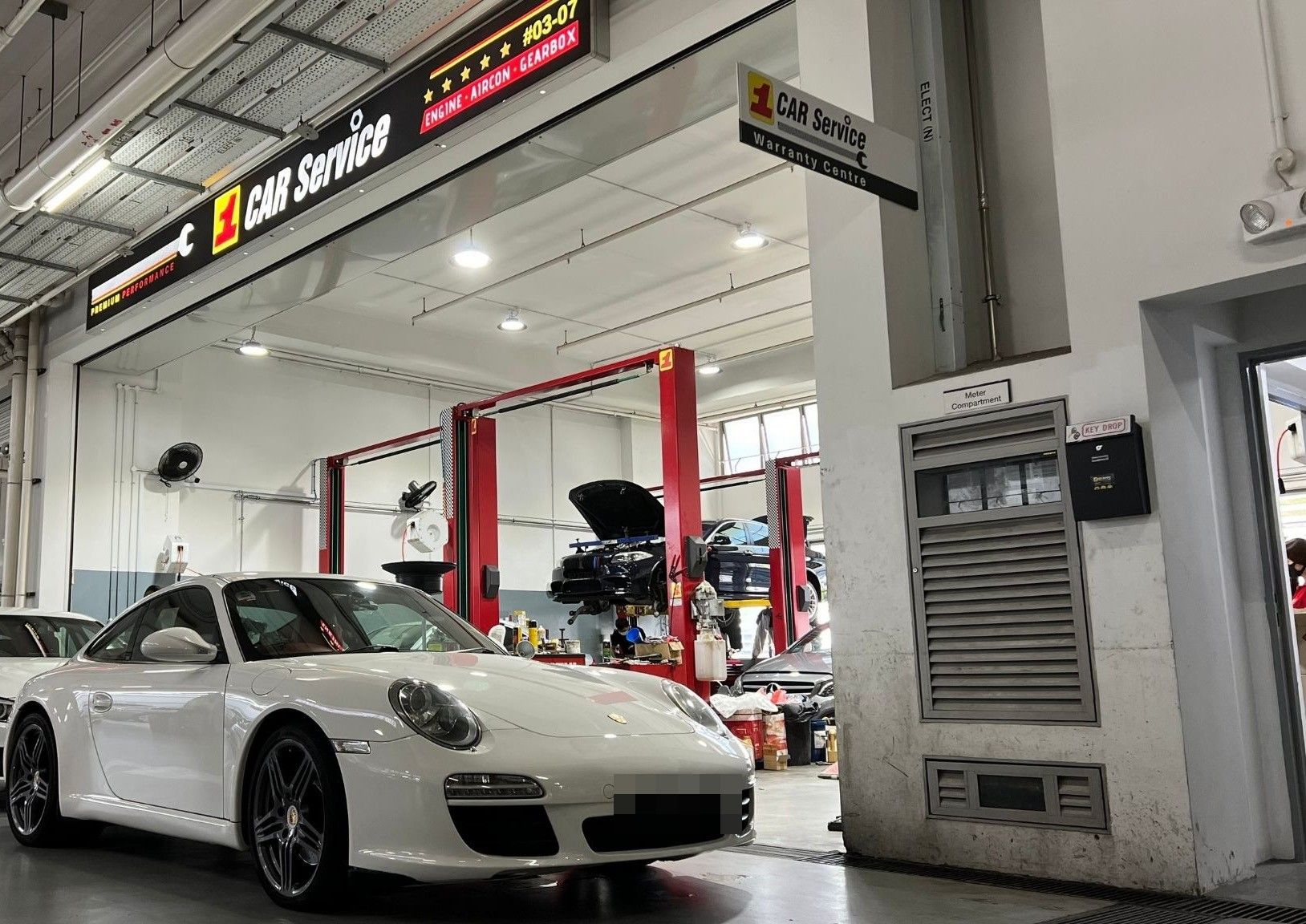
Fair is fair. We are 1 Car Service at Sin Ming AutoCity, and here is our own scorecard against the list above. Diagnostics: PIWIS, ISTA, XENTRY, ODIS and VIDA in-house, matched to the marque. Process: gearbox diagnosis always free with no conditions, an honest itemised quote before any work, and nothing done without your approval. Warranties in writing: 2 years or 40,000km on a full gearbox overhaul and 3 years or 60,000km on an engine overhaul, whichever comes first in each case, plus 1 year on aircon repairs and at least 6 months on electrical repairs. Track record: 4.9 stars from over 1,600 Google reviews, and you can read the genuine reviews for yourself on our reviews page. Documentation: we publish real jobs as case studies, and their documented prices on our car repair cost page. Payment: instalments available via Atome, Grab and Shopee.
Whichever workshop you choose, use the checklist. It costs you seven questions, and it filters out the mistakes that cost thousands.