What each repair involves on the Fit / Jazz, when to inspect or replace, and what our invoices say it costs
The figures are from our invoices. Scheduled maintenance follows the requirements for your car's engine, gearbox and model year; other repairs are assessed from symptoms, inspection and diagnostic results rather than a universal age or mileage. The notes under each repair are general guidance for cars driven in Singapore, not statistics.
Spark plugs and ignition coils on the Honda Fit / Jazz
26% of the Fit / Jazz registrations in our records had at least one invoice involving this work (58 of 220, 73 invoices in all). Those visits typically cost about $650 (middle half $500 to $1,000, 53 recent priced visits, whole invoice including GST).
Spark plugs ignite the fuel mixture, while ignition coils provide the required voltage. A failing part can cause rough idling, hesitant acceleration, misfires or an engine warning light. Leaving a misfire unresolved can damage the catalytic converter and strain related components.
We check fault codes and live misfire data, inspect the plugs and test the coils under load. We document the result, identify the failed ignition parts and give you an honest quote before work starts.
Service interval: Spark plugs have a scheduled interval that depends on the engine and plug type, and we confirm it for your car. Ignition coils are replaced on diagnosis, not on a schedule, and a misfire does not by itself mean a coil has failed.
Maintenance and early warning signs: Keep to the plug interval and have misfires checked early, because unburnt fuel can damage the catalytic converter. Early signs: rough idle, hesitation, a flashing engine light.
Battery replacement on the Honda Fit / Jazz
26% of the Fit / Jazz registrations in our records had at least one invoice involving this work (58 of 220, 66 invoices in all). Those visits typically cost about $400 (middle half $300 to $500, 37 recent priced visits, whole invoice including GST).
The battery supplies power for starting and supports the car's electrical systems. Slow cranking, dim lights, warning messages or intermittent electronics can point to low voltage. Waiting may leave the car unable to start, while unstable voltage can trigger misleading faults.
We load-test the battery, measure charging output and check for an electrical drain where needed. Our findings show whether the battery, charging system or another circuit needs attention, with a documented honest quote before work begins.
When to inspect or replace: The starter battery is tested at every service and replaced on the test result rather than at a set age. Cars with a separate auxiliary battery for the stop-start system or the electronics have that battery tested and replaced the same way, and it is counted in this row. Hybrid drive batteries are a separate matter.
Maintenance and early warning signs: Short trips and daily aircon use are hard on a battery in Singapore; give the car a longer run where you can, switch accessories off before the engine, and park in shade. Early signs: slow cranking, lights dimming at idle, stop-start no longer working, a warning about the auxiliary battery, electrical warnings that come and go.
More on this repair at 1 Car
Gearbox oil changes on the Honda Fit / Jazz
25% of the Fit / Jazz registrations in our records had at least one invoice involving this work (54 of 220, 66 invoices in all). Those visits typically cost about $650 (middle half $500 to $1,000, 52 recent priced visits, whole invoice including GST).
Gearbox oil lubricates moving parts, carries hydraulic pressure and helps control heat. Degraded or contaminated fluid may be involved when shifts feel hesitant, rough or noisy. Poor lubrication can accelerate internal wear and turn a maintenance job into a deeper repair.
We inspect the fluid and leaks, road-test the shift behaviour and review transmission data. We decide whether the car needs the specified fluid service or targeted fault tracing, then document the recommendation and provide an honest quote before starting.
Service interval: Follow the interval and fluid specification for your gearbox and model year; they differ between gearbox types even within one model, and we confirm them for your car. Where the maker lists no change for the life of the car, ask us whether a preventive change makes sense for your gearbox and driving.
Maintenance and early warning signs: Use the specified fluid and fill procedure, with the filter where your gearbox has a serviceable one, and avoid hard launches while the gearbox is cold. Fresh fluid is maintenance, not a cure for a gearbox that is already faulty. Early signs: a burnt smell, dark fluid, shifts that have become rough.
More on this repair at 1 Car
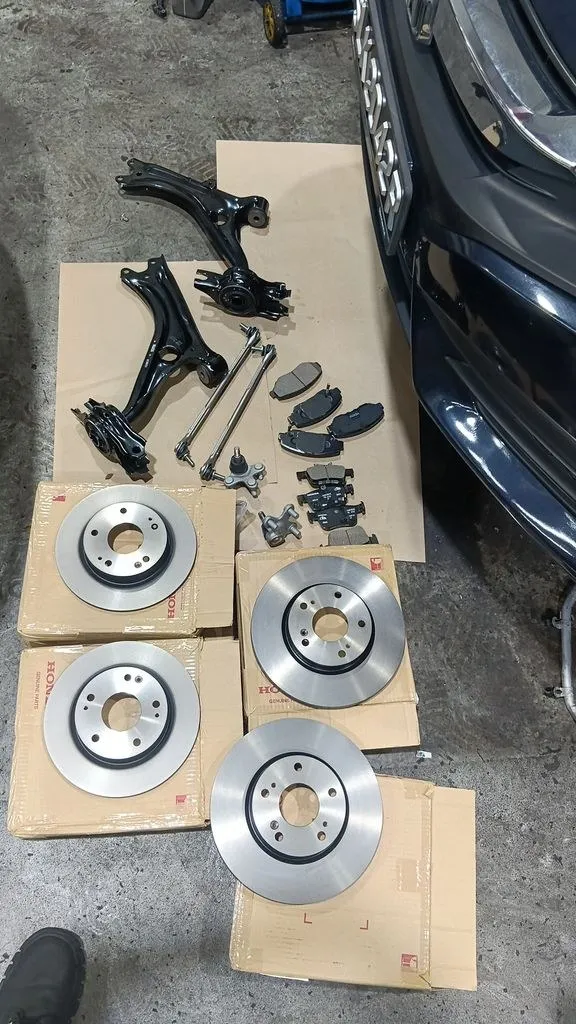
Brake pads, discs and wear sensors on the Honda Fit / Jazz
15% of the Fit / Jazz registrations in our records had at least one invoice involving this work (33 of 220, 37 invoices in all). Those visits typically cost about $950 (middle half $600 to $1,000, 17 recent priced visits, whole invoice including GST).
Brake pads press against the discs to slow the car, while fitted wear sensors warn when attention is due. Squealing, vibration, pulling or weaker braking can signal wear or damage. Delaying the work may damage the discs or calipers and reduce braking control.
We measure the pad material and disc condition, then inspect the surfaces, sensors and caliper operation. We record what is worn, recommend only the required brake parts and quote honestly before any work starts.
When to inspect or replace: Pads and discs are measured at every service and replaced by thickness and condition against the limits for your car, not by mileage. Discs are judged on the same measurement, not on a fixed number of pad changes.
Maintenance and early warning signs: Brake early and gently, leave a gap so you roll instead of stopping at every light, and use engine braking on long descents; stop-and-go traffic wears pads and discs faster. Early signs: squeal, grinding, a pulse through the pedal, a wear warning on the dash.
More on this repair at 1 Car
Fan belts, tensioners and pulleys on the Honda Fit / Jazz
7% of the Fit / Jazz registrations in our records had at least one invoice involving this work (15 of 220, 17 invoices in all). Those visits typically cost about $1,000 (middle half $600 to $1,250, 13 recent priced visits, whole invoice including GST).
The belt transfers engine drive to essential accessories, while the tensioner and pulleys keep it aligned. Squealing, chirping, rattling or visible belt damage can indicate wear. If the belt slips or breaks, charging or cooling may be affected and further damage can follow.
We inspect the belt for cracking and fraying, check its tension and alignment, and turn the pulleys to find rough bearings. We pinpoint whether the belt, tensioner or pulley has failed, document it and give you an honest quote before repairs begin.
When to inspect or replace: The drive belt is inspected at every service and replaced on condition or on your car's schedule; the tensioner and pulleys are assessed separately.
Maintenance and early warning signs: Fix oil and coolant leaks that soak the belt, and have squeals or rattles checked before the belt fails. Early signs: a squeal on cold start, a rattle at idle, cracked belt ribs.
Gasket, seal, cover and housing oil leaks on the Honda Fit / Jazz
6% of the Fit / Jazz registrations in our records had at least one invoice involving this work (14 of 220, 17 invoices in all). Those visits typically cost about $1,250 (middle half $1,150 to $1,400, 11 recent priced visits, whole invoice including GST).
Gaskets and seals keep engine oil inside while allowing joined parts and rotating shafts to work. Oil spots, a burning smell, smoke or a falling oil level can reveal a leak. Waiting can reduce lubrication and allow oil to damage nearby rubber parts or coat hot surfaces.
We clean the affected area and trace the leak from the highest wet point, using dye when the source is unclear. We identify the leaking gasket, seal, cover or housing instead of blaming the whole engine, then document it and quote honestly before work starts.
When to inspect or replace: Checked at every service and repaired according to the source and severity found, from a weeping seal to a housing. No age makes a leak due.
Maintenance and early warning signs: Change the oil on time to the maker's specification, and fix small weeps before they reach belts, mountings and electrical parts. Early signs: drips under the car, a burning smell after driving, a falling oil level.
More on this repair at 1 Car
Aircon compressor repairs on the Honda Fit / Jazz
6% of the Fit / Jazz registrations in our records had at least one invoice involving this work (14 of 220, 15 invoices in all). Those visits typically cost about $1,200 (middle half $950 to $1,350, 9 recent priced visits, whole invoice including GST).
The compressor circulates refrigerant so the aircon can remove heat and humidity from the cabin. Warm air, weak cooling, unusual noise or erratic operation can point to a compressor or related system fault. Continuing to run a damaged compressor may spread debris and turn a targeted repair into wider aircon work.
We compare system pressures and outlet temperature, check the compressor command and trace refrigerant leaks. The readings let us separate compressor failure from an airflow, control or refrigerant fault, with documented findings and an honest quote before work begins.
When repair may be needed: Replacement follows a confirmed compressor fault, not the car's age. Weak cooling on its own does not mean the compressor has failed, so any change in cooling, a new noise when the aircon engages or a compressor that no longer cuts in is assessed first.
Maintenance and early warning signs: Run the aircon regularly, keep the condenser and grille clean so the system is not working against high pressure, and have weak cooling investigated rather than topped up with gas again and again. Early signs: cooling that fades in traffic, a rattle or whine when the compressor engages, a clutch that cycles on and off.
This aircon repair is covered by a warranty of at least 6 months.
More on this repair at 1 Car
Wheel bearings and hubs on the Honda Fit / Jazz
4% of the Fit / Jazz registrations in our records had at least one invoice involving this work (9 of 220, 9 invoices in all). Fewer than 8 recent visits carry a comparable whole-visit price, so we quote this on WhatsApp after diagnosis.
A wheel bearing supports the vehicle load while allowing the wheel to rotate smoothly. Humming, growling, vibration or noise that changes while turning can suggest wear. Delaying attention may damage the hub, affect tyre wear and reduce wheel stability.
We road-test the noise, check the raised wheel for play and roughness, and inspect the hub, tyre and brake for other causes. We confirm whether the bearing or hub is at fault and provide a documented honest quote before replacing anything.
When to inspect or replace: Inspected for play and noise during servicing and replaced on confirmed wear, not at a set mileage. A hum is checked before it is blamed on a bearing.
Maintenance and early warning signs: Slow down for potholes and humps. Early signs: a hum that changes with speed or when cornering, play at the wheel.
Sensors, switches and control modules on the Honda Fit / Jazz
4% of the Fit / Jazz registrations in our records had at least one invoice involving this work (8 of 220, 10 invoices in all). Fewer than 8 recent visits carry a comparable whole-visit price, so we quote this on WhatsApp after diagnosis.
Sensors report operating conditions, switches send commands and control modules coordinate the car's systems. Warning lights, failed features, poor running or an electrical drain can appear when a component or circuit develops a fault. Ignoring the symptom may create secondary faults or leave an important function unavailable.
We scan the fault codes, review live data and test power, ground and signal circuits at the affected component. We isolate the sensor, switch, wiring or module responsible, document the evidence and quote honestly before work starts.
When repair may be needed: Diagnosis-led: a fault code names a circuit, not a part, so we test the sensor, switch, wiring and module before anything is replaced.
Maintenance and early warning signs: Keep sunroof drains, door seals and boot seals clear so rain stays out of the cabin and boot, fix battery and charging faults early, and never jump-start with the polarity guessed. Early signs: warning lights that come and go, features that drop out in the rain, an unexplained battery drain.
Absorbers, arms, bushes and links on the Honda Fit / Jazz
4% of the Fit / Jazz registrations in our records had at least one invoice involving this work (8 of 220, 10 invoices in all). Fewer than 8 recent visits carry a comparable whole-visit price, so we quote this on WhatsApp after diagnosis.
Suspension parts control wheel movement, absorb bumps and help keep the tyres planted. Knocking, bouncing, pulling, vague steering or uneven tyre wear can indicate a worn component. Waiting may worsen handling and place extra load on tyres, joints and nearby mountings.
We road-test the car and inspect the mountings, bushes, joints and absorbers for play, damage or leaks. We identify the failed arm, bush, link or absorber rather than replacing the whole suspension, then document it and give you an honest quote before work begins.
When to inspect or replace: Absorbers, arms, bushes and links are inspected on a lift and on a road test and replaced individually when worn, leaking or split. They do not share one lifespan.
Maintenance and early warning signs: Slow down for humps and rough roads, avoid mounting kerbs, and keep tyres at the right pressure. Early signs: knocks over bumps, a bouncy or floaty ride, uneven tyre wear, wandering steering.
More on this repair at 1 Car
A repair may sit at the lower end when the fault is isolated and access is straightforward. It can rise when related parts are worn or diagnosis reveals wider damage. The statistic shown is a guide from recorded work, not a quote for your car.